Why HIP-3?


Key Takeaways
Perpetual futures remove expiry, use leverage for capital efficiency, and allow 24/7 global trading.
They were absent in traditional finance due to regulatory and economic reasons, while crypto provided the environment to make them possible.
HIP-3 turns infrastructure into a utility, shifting the focus from building exchanges to creating markets with capital and demand.
For investors, HIP-3 expands into traditional markets and enables entirely new ones.
1. Speculation’s Constant
Speculation is a constant. The only thing that changes is the wrapper that makes it easier. In equities it was the ticker tape, in commodities the futures pit, in crypto the perpetual futures. Each wrapper survived because it stripped away friction and made speculation more efficient.
Perps are simply the latest and most efficient wrapper we’ve found. They eliminate time (no expiry), compress capital (margin and leverage), and erase geography (24/7 access). Once traders tasted that combination, they did not go back. That is why perps went from a fringe experiment to over $6 trillion in monthly volume at the latest peak, more than 90% of all crypto derivatives flow.
If perps are so efficient, why didn’t they exist in traditional markets? The answer lies less in economics and more in regulation and path dependence. TradFi derivatives evolved under rules that required expiry, delivery, and clearinghouse oversight. A perpetual contract that runs 24/7 with floating funding payments would have never been allowed.
Crypto provided the blank slate. Global collateral, continuous markets, and no regulator blocking design space. That sandbox made perps possible, and once they proved themselves, they became crypto’s default instrument.
But proving themselves inside crypto is different from expanding beyond it. That is where a second bottleneck has held them back.
2. Shifting the Bottleneck
For decades, the scarce resource in market structure was infrastructure. Who could build the exchange? Who could maintain the matching engine, the risk systems, the liquidation logic? These were expensive, technical endeavors, guarded by capital and regulation.
HIP-3 changes that. Infrastructure becomes a commodity, available as a utility. The scarce resource is no longer the ability to build an exchange, but the ability to rally capital and belief around a market worth trading.
A skeptic might ask "if infrastructure was the bottleneck, why didn’t Binance or Bybit (who already had it) launch non-crypto perps?" The reason wasn’t technical; it was regulatory and economic. A Tesla or Treasury perp listed by a CEX would have been an unlicensed derivative, a direct target for regulators. And even if tolerated, the upside was negligible compared to the billions they already earn from BTC and ETH perps. For them, exotic markets carried asymmetric downside and trivial upside.
For HIP-3 builders, the calculus is different. The infrastructure is shared, the cost of trying is limited to the bond, and the reputational or regulatory risk sits with the deployer, not the protocol. What a centralized giant avoided as a liability, a smaller, specialized actor can pursue as an opportunity.
This is a profound structural shift. The gatekeepers of speculation have always been exchanges themselves: they chose what was listed, and by extension, what could exist as a tradable market. HIP-3 dissolves that role. Any group that can post the bond can attempt a market; the crowd will decide whether it lives. The bottleneck moves from institutions to demand.
3. Why HIP-3
So how does this actually work in practice? HIP-3 breaks the old bottlenecks in three ways:
3.1 Infrastructure is no longer expensive
A high-performance CLOB isn’t something you spin up on Solidity. Matching engines, liquidation logic, and risk systems typically take years, dozens of engineers, and tens of millions to build. That’s why most perp DEXs fall back to AMM designs that can’t scale.
HIP-3 shortcuts all of that. Builders deploy directly on HyperCore — a backend proven to process hundreds of thousands of orders per second with sub-second finality. Instead of spending years reinventing infrastructure, launching a new exchange becomes an API call plus a bonded stake.
3.2 Liquidity no longer carries high integration cost
Most new venues die not from lack of demand but from lack of liquidity providers willing to integrate. Each new exchange usually means new APIs, risk models, and latency quirks — weeks to months of work for uncertain payoff.
HIP-3 doesn’t remove the fact that each DEX has its own orderbook. Fragmentation still exists at a structural level. But it changes the economics. Because all HIP-3 markets run on the same backend, the integration surface is identical. For a market maker already quoting on Hyperliquid, supporting a new HIP-3 market is close to zero incremental cost: same API, same latency profile, same risk logic. That means markets can be tested cheaply, but liquidity doesn’t stay scattered — it concentrates where volume justifies it. Cold start costs collapse. If a Tesla perp launches and traders show up, makers can plug in immediately. The result is faster experimentation without permanent fragmentation.
3.3 Oracles no longer require custom fixes
Every perp market lives or dies on its oracle. Rolling your own is fragile, and history shows why. When Mirror tried to track silver, the feed drifted over the weekend, creating wild divergence between on-chain and off-chain prices.
Stocks don’t trade on weekends. Commodities have limited sessions. If a perp runs 24/7 while its oracle is frozen, distortions appear. HIP-3 doesn’t eliminate this risk, but it standardizes how builders handle it.
Deployers can plug Pyth, Chainlink, or custom composites directly into HyperCore, and set explicit closure policies: freeze the book, use a TWAP, or rely on proxy feeds like CME futures. The point is not that HIP-3 solves oracles once and for all. It won’t. The point is that builders no longer need to reinvent fragile infrastructure every time they try a market. Predictability replaces fragility, and credibility rests on predictability.
4. Speculation Unbound
Once infrastructure is no longer the choke point, speculation routes itself wherever prices and attention exist. A Tesla perp, a gold 100x perp, a long/short pair perp (i.e. ETH/BTC), a SpaceX pre-IPO contract, a sneaker index, a cultural benchmark. These are not fantasies but natural experiments once the cost of creation collapses.
The obvious critique here is that it will spawn a Cambrian explosion of zombie markets. If spinning up an exchange is an API call, won’t liquidity just scatter across hundreds of dead books?
In practice, liquidity is self-correcting. Makers still concentrate balance sheets where spreads are profitable. Frontends and aggregators route flow to the deepest books. And the 1M HYPE bond functions less as a conviction filter and more as a spam deterrent, it raises the cost of launching a market high enough to block scams, but not high enough to stop serious deployers from experimenting broadly.
Most markets will fail, as they always have. But now failures are cheap and reversible, while successes compound faster than in today’s world. HIP-3 doesn’t create endless fragmentation, but it channels it. More rivers are allowed to form, but liquidity still finds its way to the sea.
5. Implications for Capital
For investors, this means two things.
First, HIP-3 pulls in existing flows. Perps will not remain confined to crypto assets; they will bleed into equities, commodities, and entirely new categories. Even if only 1% of traditional derivatives activity migrates on-chain, that implies a 10–20x expansion of current perp volumes.
Second, HIP-3 enables markets that never existed before. The surface area of speculation expands dramatically. Pre-IPO equity, pair trading (i.e. ETH/BTC long/short), collectibles, prediction markets, cultural benchmarks. HIP-3 lowers the barrier to try. Most will fail, but a fraction will compound into durable liquidity pools. That’s how you get to a 20x+ upside.
At the same time, the economics of exchanges shift. If infrastructure is utility, the scarce assets become distribution, capital, and trust. Value accrues not to fortress exchanges, but to the networks and communities that can mobilize demand.
6. Demand Is Already Here
HIP-3 already has a pipeline of projects prepared to launch markets the moment it goes live. These teams bring capital, distribution, and users, ensuring that HIP-3 doesn’t start empty.
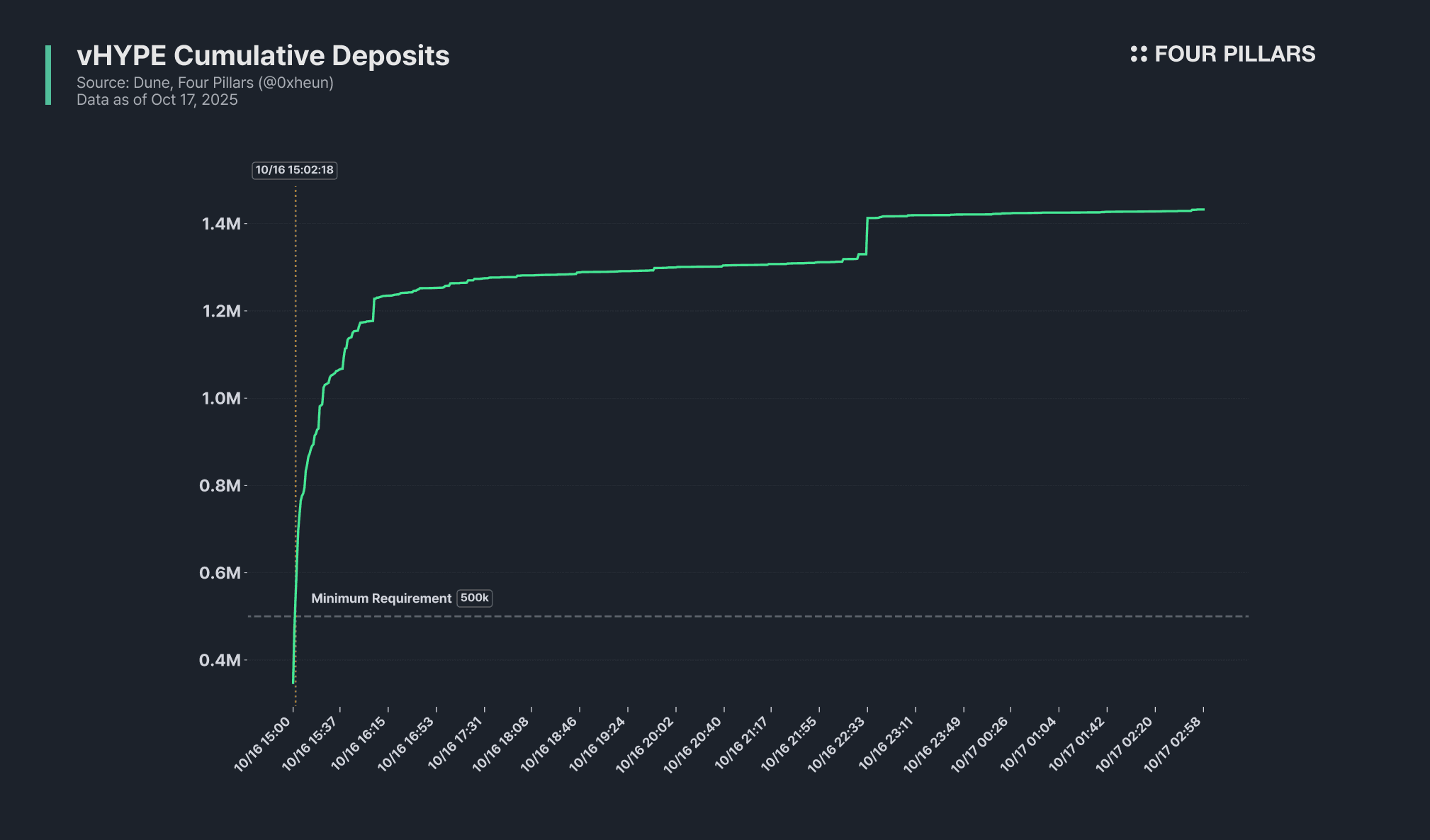
Kinetiq is solving the capital barrier. The 1M HYPE bond (over $55m at current prices) is an effective spam filter but out of reach for most startups. Kinetiq’s Launch platform pools community stake to post the bond on behalf of builders. Contributors receive exchange-LSTs tied to fee flows, democratizing HIP-3 access and preventing capital from becoming the choke point.
Ventuals is developing pre-IPO equity perps — contracts tracking companies like SpaceX or OpenAI, which cannot be listed on CEXs but have obvious demand. This is a textbook HIP-3 use case: turning illiquid private market speculation into liquid, continuous price discovery.
Liminal, an execution protocol for delta-neutral and basis strategies, can use HIP-3 to expand into structured perps, exotic spreads, and other CLOB-dependent instruments, effectively opening a new product line.
BasedApp, one of the largest 3rd-party frontends in the HL ecosystem, already processes ~1.5% of HL perp volume ($20m annualized). With HIP-3, it can list and distribute custom markets directly to users, ensuring that new markets launch with built-in exposure and order flow.
Aura is introducing perpetual contracts on U.S. Treasuries using HIP-3 and Pyth oracles. Aura extends crypto speculation into traditional finance and creates 24/7 on-chain access to instruments that are otherwise gated to institutions.
7. The Prize
The immediate numbers are compelling. Trillions in crypto perps today, tens of trillions in traditional derivatives tomorrow. But the larger prize is structural. HIP-3 marks the moment when speculation ceases to be tied to a building, a committee, or an exchange, and becomes instead a utility.